
On Desire
essay and verse

ON DESIRE
“It’s that the soul of every human being, when intensely pleased or pained at something, is forced at the same time to suppose that whatever most affects it in this way is most clear and most real, when it is not so; and such objects (the things that cause us intense pleasure and pain) are things seen..”- from Plato's “Phaedo”
I’ve never been a Don Juan. That kind of intense passion (beyond just finding myself relatively attracted to relative attractiveness) has only ever shown up once or twice, and not for long. So attachment to passing things in the sense of physical beauty hasn’t been a major issue. However, on the other side – aversion, intense passionate aversion, known as hatred- yes, that appears as frequently as the dawn. I hate very easily, despite hating myself because of it. I know -relatively- why I hate, and that is because I fear. But who knows from where these phantoms arrive? I love a memory and an idea of the world, and yet, I hate it’s presence. Total confusion.
In Plato’s “Phaedrus” dialogue, the character of Socrates seems to offer a way for those of the more Don Juan-esque disposition to realise the true source of their longing, and by way of seeing it merely reflected in the sensual ‘objects’ of their desire, in beauty of bodies, awaken themselves to the real beauty of real Being, beyond the empty illusion of this unreal realm of flesh and blood, of becoming. Without, it must be added, denying the illusion it’s beauty, even if it is mere reflection.
You can’t do that with aversion; not without ending up in the absurdity of saying that this world is only a reflection of true ugliness and hatefulness.
I suppose this touches on Martin Heidegger’s concept of the ‘ontological difference’. Basically, Heidegger says that the question of Being has two modes, which he calls ‘ontic’ and ‘ontological’. Ontic means, or is concerned with, beings; dogs, rivers, mountains, stars, atoms, gods, people. Ontological on the other hand means, or is concerned with, Being itself; what does it mean to be? When we say ‘being’, what is meant?
Heidegger says that for the ancient Greeks the ontological question revealed itself in it’s purity, but that it was quickly covered over, and confused with the ontic. Thus, for example, in Aristotle the ontological question of what is “divine being” , with it’s emphasis on being rather than divine (the latter is a mode of being rather than Being itself). This was interpreted in the Middle Ages under the influence of Judaeo-Christian-Islamic religion in the ontic sense, and thus became a question about a divine being, in other words, the Abrahamic god, rather than about divine Beingness.
For Plato, says Heidegger, ‘Being’ revealed itself as ‘Idea’, eidos; the look (of something), what appears in beings; for instance, what appears in a person is the Idea of human being-ness, what appears in a horse is the look, or Idea of horseness.
What Plato taught is that the sensory world, the world we ordinarily believe to be the most real, is a mirage of constantly fluctuating, passing, and imperfect reflections (eidola) of what is real, in other words, the Ideas which never themselves appear to the senses, but can only be (somewhat, or at least, after sufficient effort) seen by the mind.
What appears to the senses is not real, is non-being. However, when talking about what is real Being, the Ideas, the danger is to treat them as we would an apparent being in this world; the Idea of horseness is not a thing, a being, in the way a particular horse is a being. The Idea is ontological, the particular is ontic. And it is thus extremely difficult to talk about the former in a way that won’t be easily misunderstood.
So, it is not really that important, at least in relative terms1, whether it is the intensity of the attraction or repulsion that serves to indicate the confusion in our awareness of what is real and what is not. That is to say, the particular beings which appear through the senses are passing/changing and always incomplete, and therefore cannot be the unchanging reality of Being. The intention is not, having gotten a sense of the unreality of this sensory world and it’s phantom beings, to replace them in our heads with another set of beings, only considered the real beings and objects, in contrast to a fake hologramatic kind-
Instead, perhaps, it is to thoroughly understand what thorough illusion this world thoroughly is; subject, objects, and everything between.
Perhaps. But I can’t claim any success at it.
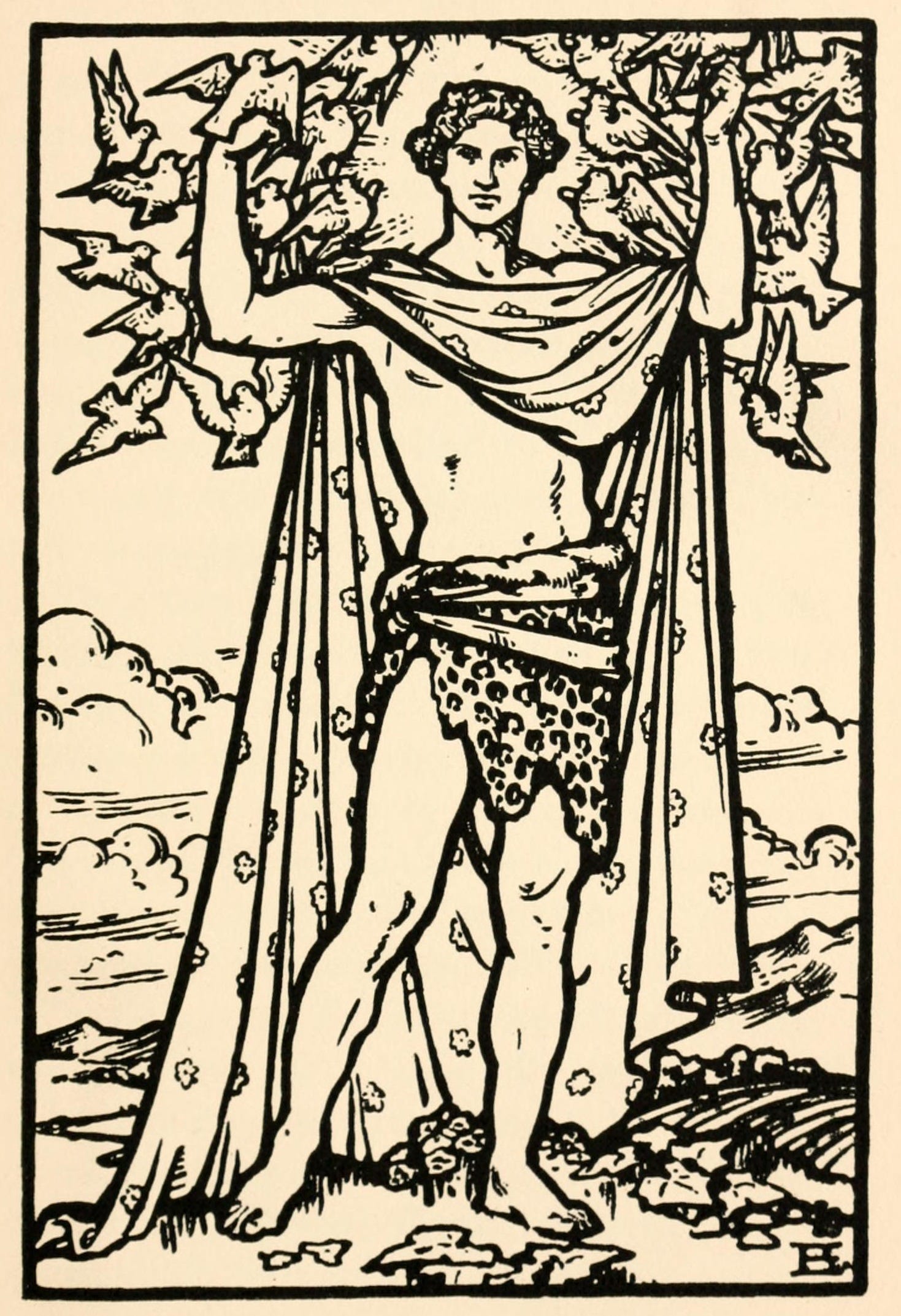
EROS
Until the quills and plumage, down,
the cycle turns, again am free
to fly, without the blooming crown
of pain that doomed this life for me
***
So says the dweller of the Sidhe2,
behind the aching eye and skull,
who tells, though limited it be,
a sliver true of wisdom full
Though I certainly wouldn't recommend anger or hatred as at all easy ways to work with seeing the truth. In fact, I think it could be quite dangerous to elect such ways.
Sidhe is a burial mound in Ireland and Scotland - the places which are believed to be inhabited by the otherworldly beings, the native gods. I am using the term as a metaphor for the human head, the skull, and mind
Love this, but footnote, please, for the word Sidhe. 💜💜💜💜😊😊😊😊