
Severance
Essay and verse

“the same is for thinking as for being” says Parmenides
For the Aristotelian philosopher. Alexander of Aphrodesias, the Active Intellect (NOUS POIETIKOS) is the Unmoved Mover, the ultimate object of thought. As the absolute reality, perfect Being in the sense of Energeia (full actualisation) it is what all relative beings are striving towards. It is engaged in eternal and blissful contemplation of the intelligibles, the essential forms which are immanent in the world perceived by us with our material senses and intellects. As such, the Active Intellect is the great sun of the noetic realm, illuminating for our minds the metaphysical principles of the universe just as the physical sun does for our eyes.
There are similarities between how Alexander describes this great Intellect and the Vedic or Vedantic conception of Chaitanya, the eternal consciousness of the ATMAN, the ultimate self. Moreover, both the Atman and the Active Intellect are transcendent to the world of ordinary experience. As ultimate object, in the Aristotelian sense, the Active Intellect must also be a substance, that is to say, a subject. All relative and perishable subjectivities (like ourselves) are impelled by a desire to reach such perfection of subjecthood as this ultimate object. The Atman as supreme subject, unrecognised by the ego while enthralled to the illusion of separate existence, may appear, or be talked about as if an object (though in reality it is beyond such articulation).
The main distinction between these two conceptions of the absolute – Aristotelian and Vedantic – as far as I can see, is the assumed orientation of the thinking which approaches them; it seems that Aristotle and his successors including Alexander were directing their thoughts ‘outwards’ and touching on the transcendent by means of investigation of the ‘external’ world, while the Vedantic sages meditated ‘inwardly’ to reach the transcendent in their “own immanent depths” as the Kyoto philosopher Nishida Kitaro might have put it.
In any event, these two strands of Indo-European wisdom both point to, both potentially furnish us with conceptual keys for opening up the door to a transcendent ultimate reality, beyond the ever changing and illusory nature of this world, including ourselves.
And just as for Aristotle himself, thought and the object of thought are ultimately one, so Alexander’s God (which is a name for the Active Intellect) cannot be utterly separate from our minds – in the sense that when we contemplate intelligibles, we momentarily cease our otherwise total immersion in the ‘physical’ realm.
It seems Alexander was concerned with stripping away what he doubtless regarded as the mystical condiments of Platonic influence on Aristotle’s philosophy, and so insisting that the Active Intellect be a separate entity from ourselves and the physical universe. Nevertheless, the mere fact of there being a physical universe as such, relative to the being of the Active Intellect, and since for Aristotelians the universe is eternal (in the sense of uncreated) then the latter, though of a lesser order cannot be absolutely separate from the former (and visa versa).
If nowhere else, the interface between such ontological strata is the human being, that place wherein as Parmenides says- “the same is for thinking as for being”
NUADA’S FORM1
Severed was the strongest hand
of Eire’s daimon lord of old,
Nuada, never long unmanned-
with silver fair his form made whole
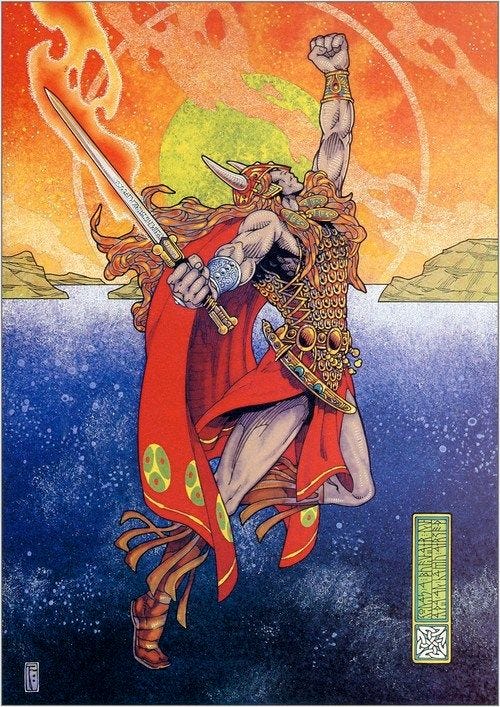
Nuada was a king of the Tuatha De, the tribe of gods of the Gaelic people. The medieval narrative of the first battle of Mag Tuireadh recounts how his sword arm was severed, but then replaced by a silver one (which subsequently was transformed into full ‘flesh’.
The question of externalities always leads us back to the qualities of perception. Most people quit the inquiry with the conclusion that there is an outer world, outer space, case closed. This approach is very comforting. It upholds truckloads of assumptions.
I wonder, though about this. Isn't it ultimately true that there is no external perception? So, if anything we can perceive is due to the inner quality of perception, how do we know that the inner perception is registering an outer world?
Put another way, there is always an inner facet to any external perception, so anything we can perceive cannot be fully and completely an external phenomenon. At the very least, a quality of ourselves must participate in the perception.
Thus to perceive the forms, the five solids, and the unmoveable mover means that there is a quality with at least some of us that participates therein. This means that it is impossible for source to be fully external from our subject-object assumptions.
Right up my alley, thank you. I’m putting together a workshop on Parmenides and Heraclitus and have been reading Zubiri on the parallels and differences between the Greek/Aristotelian view of nous and being, and the Vedantic one. Here's a fragment:
"Primitive Indian philosophical literature does not rest on the verb as-, “to be”, but on the verb bhū-, equivalent to Greek phyein, in the sense of being born and engendering. All the exuberant richness of the intellectual nuances of things is expressed through the innumerable forms and derivatives of this second verb: things are bhūta-, engendered beings; the entity is bhū, the born one, etc. The verb as- by contrast has no other function than that of a simple copula, so inconsequential that Indian thought never truly arrived at the idea of essence. It is not that Vedānta absolutely lacks something equivalent to our notion of essence; but it is only a remote equivalence.
For the Greeks, essence is a purely logical and ontological feature: it is what in things corresponds to their definition and what gives them their proper nature. The Indian, on the other hand, always subordinates these notions to others that are more elementary and of a different character. For him, essence is above all the purest extract of the activity of things, in the same sense in which we still use the word today when we speak of an “essence” in perfumery. So much so that one of the most primitive names for what we call essence is rasa-, which strictly means sap, juice, generating and vital principle.
This difference reaches all the way to the very idea of being. Whereas for Parmenides and for the Greeks in general —to put it somewhat schematically— the characteristic of being is “to stand”, to persist and, therefore, to be immutable, not to change (akíneton), for Vedānta being (sat-) is rather that which possesses itself in perfect stillness, in unalterable peace (shanti-). This opposition between Eleatic stillness and Vedāntic calm or peace cannot be forgotten in favour of external analogies, and keeping it in view prevents us from hastily identifying on and sat-.
Indian thought is the reality of what Greece —and therefore the whole of Europe— would have been without Parmenides or Heraclitus: in Aristotelian terms, a speculation entirely about things without ever bringing the “are” into play; something that, very remotely, recalls gnosis. This slight variation in the target of thought was enough to give rise to Parmenides and Heraclitus.
By interpreting Brahman as universal soul —the identity of ātman and brahman— the Indian arrived at a kind of ontogony. By taking Nature as a force of being, we will arrive at an ontology. But one more step is needed: that will be the work of the generations immediately after the Persian Wars. From that point on, Wisdom will no longer be a simple vision of Nature, but a vision of what things are, of the principle and substance that makes them be, of their being."