
Soul-flight
essay and verse

SOUL-FLIGHT
I woke this morning from another very vivid dream of a singular house in a laneway. I have dreamed it many times before, always from the outside, always in twilight. It is a two storey, red brick house with a tiny walled front garden and a gate. The lane is dark, but wide and covered in uneven black tarmac sloping down to a narrower entrance onto another road of red brick houses. It all seems intimately familiar to me. Does it, has it ever existed in the waking world?
Only last week while accompanying my father to a diabetic clinic, I found myself in a place, a newly built estate or development, of which I had not known before- except that I had often dreamed it. There are no doubt persuasive and perfectly acceptable sceptical arguments against any claims of pre-cognitive knowledge, or (how I understand it) sleeping soul-flight, but that sceptical attitude doesn’t immediately appeal, in this instance anyway, to me.
For me, it does seem that some aspect of consciousness can extend throughout the environment while the associated body sleeps. This touches on the famous mind-body problem which became a main concern in western philosophy following Descartes. It was not unknown before the 17th century French philosopher, but it entered the form in which we know it today with his handling of the issue. Some of the ancients, the Platonist Antiochus of Ascalon for example, had a similar understanding of the mind as the organ of perception, rather than the sense bases. This also happens to be how my favourite philosopher, Arthur Schopenhauer, regards perception (as opposed to mere sensation).
The force of Descartes’ philosophical refocusing of the issue is manifest in what is today, at least in the west, the common sense understanding of the world wherein there is an external reality which is perceived by individual minds, minds being in some sense ‘internal’ to living organisms and having something to do with the brain or central nervous system. In that form, as an aspect of the general issue of consciousness or the soul, such a commonly held dualism would not be a surprising or necessarily inimical position to ancient Indo-European philosophy.
In fact, one could read several Platonists, Aristotelians, even or especially Pythagoreans as largely dualistic in their conception of reality. However, apart from the more radical of their number such as Plutarch and Numenius, this dualism is not of a thoroughgoing variety in the commonly understood Cartesian sense, which in our highly materialistic intellectual environment equates to the supposedly impossible conundrum of how ‘physical stuff relates to thinking stuff’, as if we were talking about two chemical substances.
It may be that dualism proper is a paradigm associated with Iranian Zoroastrianism, at least in it’s later orthodox and Manichean forms which also seems to be a major source of Second Temple Judaism and it’s concerns with redemption and the afterlife. However monism, and especially so-called metaphysical monism was the main paradigm of ancient Indo-European philosophy either side of the Iranian subsection.
That European thought headed in the direction of a dualism which reached critical mass with Descartes is likely the influence of, indeed the forcefully established censorious supremacy of post Second Temple Abrahamic religion, the intellectual and clerical elite of which regarded any hint of divine immanence with extreme suspicion. It is thus that more or less Platonically monist theologians like the Irishman John Scotus Erigena were pigeonholed in favour of the Aristotelian-influenced Aquinas, and further, the banishment even of panentheistically-adjacent thinkers like Malebranche to the index of condemned books.
The monism of the Platonists and the Stoics is probably best understood as a complex-monism, not unlike those of Von Hartmann and Schopenhauer respectively. That monism recognises one real Being as such, but with various degrees of non-being, becoming, or illusory appearances of that Being (to itself – the dualism between consciousness and it’s objects being an internal duality, that is, internal to the one Being). ‘Matter’ that phenomenal stuff, which at one time appeared to be so thoroughly understood but which now seems irredeemably difficult to pin down except by baroque and counterintuitive scientific theorising was for many of the ancients simply unreal in the sense of illusory. It is interesting that arguments over it’s ontological status were already extant as soon as it became a common currency concept with Democritus. I wonder if we are really any further, or possibly quite a bit behind, those original thinkers on this ‘matter’.
But, returning to this idea of an individual consciousness or soul being able to extend, or to travel beyond what might appear objectively as the individual organism, an ancient understanding of the soul was that it was not in itself individually constituted but became such when strongly identified with physicality , that is, with the world of becoming and time. In this paradigm, that we believe consciousness to be tied into a body is due to the warping effect of bodily passions and aversions which pull the soul, or consciousness, from it’s unitary condition into the world of multiplicity. When bodily passions become lessened, in sleep for example, the soul is less bound by fixed location and identification with a body, and therefore can extend someway throughout it’s original scope.
The furthest conceptual separation of reality into realms I have come across in ancient philosophy is that of Alexander of Aphrodesias who seemed quite insistent that the Active Intellect, identified with Aristotle’s Unmoved Mover, be posited as thoroughly separate from the physical universe. Nevertheless, this Active Intellect he regarded as the cause for the intelligibility of that universe to the material or passive (our) intellect, and the light by which perception of universal principles could occur. However, as an Aristotelian, Alexander regarded the soul as the embodied form, and thus a material property. Whether one could, on his definition, imagine a way in which a material intellect or soul, in a certain state, could have the barriers lowered between the material body and it’s material environment and so extend awareness in a continuity across materiality is an interesting idea.
I tend to perceive, or to be inclined to look for, a continuity in the world rather than fundamentally discrete or self-sufficient entities, though doubtless the latter may be an appearance or manifestation of the former. In this way, such dreams as I – and probably we- have of encountering places of which we have no previous physical knowledge could be accounted for by our common access to, indeed common wellspring in, a unitary active basis, a type of consciousness or soul that is not bound tight to any specific location in the world of multiplicity, but which pervades the latter and which is, in itself not multiple.
That, or I could just be a dreamer.
SOUL-FLIGHT
Never killed, nor banished root,
the kin of gods and men it bears
forever, will, the vanished truth,
within the trembling sod be there’
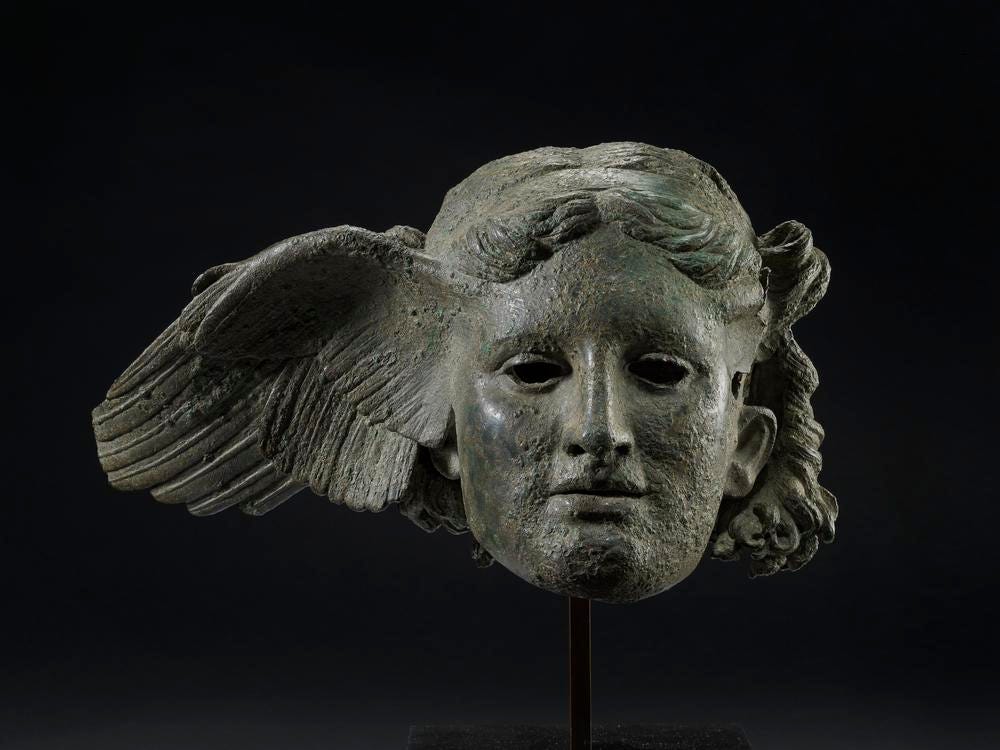
The modern psychological explanation is that we fashion our own dreams.
I actually think this is untrue. The sensory experience of our lives may help to provide a structure for the dream, yet this is very far from actually making the dream.
If we instead were to view dreaming as a journey, wherein one can be led to other places for reasons of predilection and destiny, then dreaming has something very important to say about reality, nonreality, and our place within them.
my dreams bore even me